
The aim of this three-part series is to connect the dots between the what, why and how of identifying Ultimate Beneficial Owners (UBO’s). So far we have taken a closer look at what UBO’s are and why they matter, what the challenges are when trying to identify UBO’s and so to conclude our series we will look at how Accountable Institutions can identify and manage UBOs.
Identifying and Verifying UBOs: A Step-by-Step Approach
The FIC Amendment Act requires that you identify and verify all UBOs in the same way you must identify and verify your clients.
Four Essential Steps
Step 1: Identify and Verify the Client Entity or Legal Person
Begin with the client, understand the basic legal structure, incorporation details, and regulatory status.
Step 2: Research the Ownership Structure
Conduct thorough research into how the entity is structured. This may involve:
- Reviewing incorporation documents
- Analyzing shareholder registers
- Understanding trust deeds and beneficiary structures
- Tracing indirect ownership through holding companies or other entities
Step 3: Identify the UBO Through Process of Elimination
Ask yourself the following questions:
- Who has controlling ownership of the legal person?
- The natural person/s with 5% or greater shareholding of a Proprietary company
- Shareholders in private companies
- Partners in partnerships
- Who exercises controlling rights over the legal person?
- The Elected Chairperson of a residential management company
- Board members with specific decision-making powers
- Parties with contractual control mechanisms
- Who exercises executive management control over the legal person?
- The CEO, CFO, and COO of a listed company
- Executive directors
- Persons with operational control
Step 4: Identify and Verify These UBO Parties
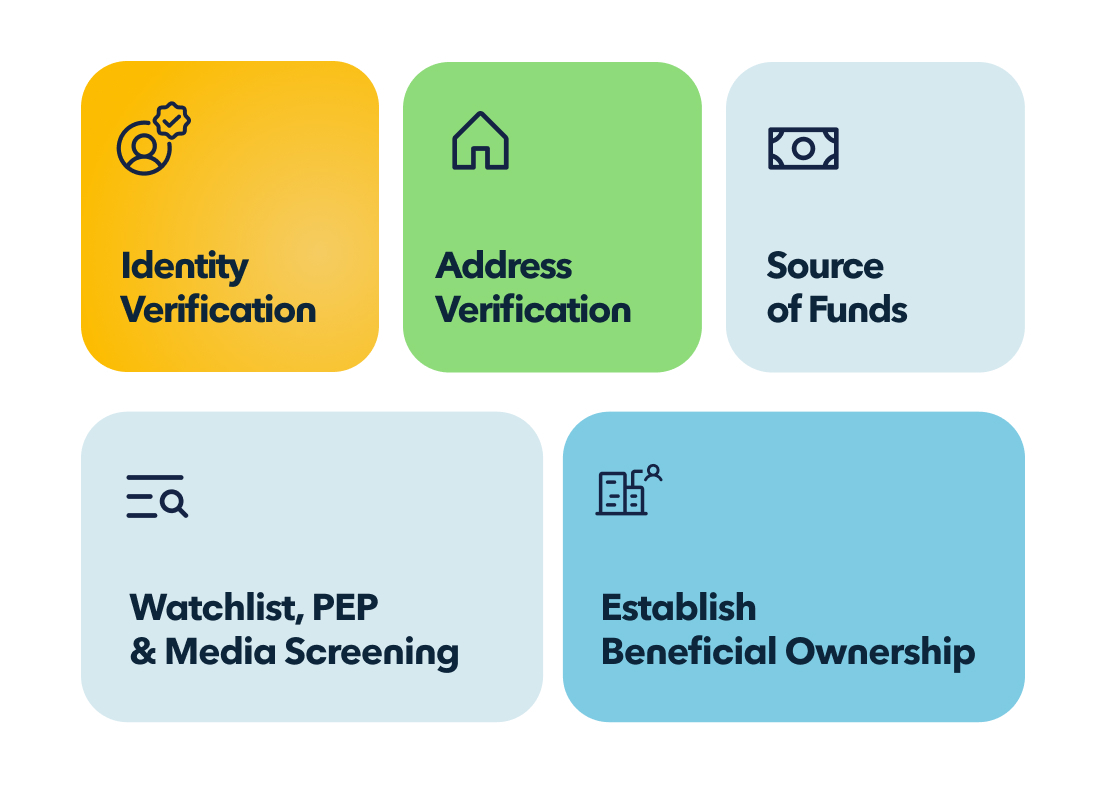
Once identified, conduct due diligence on the UBOs themselves, including:
- Verification of identity
- Adverse media screening
- Source of funds assessment
- Sanction list screening
- Assessment of UBO's risk profile
Practical Approaches to UBO Management
Risk-Based Approach
Assessing an UBO is relatively straightforward for publicly listed companies or entities with clear direct shareholders. However, it can become significantly more complex for privately-owned companies where ownership is concealed by layers of indirect ownership.
Adopt a three-line-of-defence methodology:
- Primary identification: Standard thresholds for UBO identification (typically 5% shareholding)
- Risk-based review: Enhanced scrutiny for higher-risk structures or clients
- Documentation: Demonstrate that all reasonable measures have been taken to identify the UBO
Understanding Direct vs. Indirect Ownership
Direct Relationships: A natural person holds direct ownership of the entity (e.g., owns 20% of Company ABC).
Indirect Relationships: A natural person holds ownership of the entity through one or more other entities. For example:
- Natural Person A owns 30% of Company B
- Company B owns 60% of Company C
- Therefore, Natural Person A has 18% indirect ownership in Company C (30% × 60%)
Calculating Shareholding for Complex Structures
By working through the layers of hierarchy, identifying the natural persons, and calculating their indirect holdings, you can soon identify the true ownership structure - finding that elusive needle in the haystack.
Verification Approaches
Given the lack of publicly accessible data in South Africa, it is acceptable to:
- Request client declarations around their ownership and structure
- For higher-risk clients, it may be wise to request:
- An independently verified or certified organogram
- Company structure diagrams created or reviewed by an external accountant, auditor, or attorney
- Updated corporate governance documentation
- Apply risk-based verification proportionate to:
- The complexity of the ownership structure
- The client's risk profile
- The nature and size of transactions
- The jurisdiction and transparency level
Building Your UBO Framework
Key Considerations for Accountable Institutions
Governance & Documentation
- Establish clear UBO identification policies aligned with FIC requirements
- Document your risk-based approach and approval thresholds
- Maintain detailed records of UBO verification conducted
Technology & Processes
- Implement systems that can map ownership through multiple layers
- Establish procedures for monitoring changes in beneficial ownership
- Create alerts for adverse media involving identified UBOs
Ongoing Monitoring
- Update UBO information periodically or when changes are announced
- Monitor for transactions that might indicate change of control
- Conduct adverse media screening on identified UBOs
- Review effectiveness of UBO identification on a regular basis
Training
- Ensure front-line staff understand the difference between legal ownership and beneficial ownership
- Provide practical examples of complex ownership scenarios
- Train on the risk-based approach and when to escalate for enhanced due diligence
Conclusion
Understanding who truly owns and controls your clients, not just who is listed on the legal documents, is fundamental to effective KYC and AML compliance. While navigating complex legal structures deliberately designed to conceal UBOs can present challenges, a structured risk-based approach combined with robust processes enables Accountable Institutions to fulfill their regulatory obligations.
The key is to move beyond simply accepting what is presented and to ask the critical questions: Who benefits? Who controls? And what reasonable measures can be taken to verify this?
By implementing comprehensive UBO identification and verification procedures, Accountable Institutions can significantly reduce their exposure to money laundering, terrorist financing, and other financial crimes, and demonstrate to regulators that they are taking beneficial ownership transparency seriously.

About the author:
Hawken McEwan
Hawken has over 25 years' experience in financial crime compliance, regulatory operations, banking operations, risk and change. Specialising in FICA and Anti-Money Laundering, Hawken holds a Masters from the Edinburgh University, the AMLCPrac(SA) designation, and is a Certified Anti Money Laundering Specialist, Member of the Association of International Financial Crime Investigators and South African Board member for ACAMs.