
Let me be blunt about something that does not get said enough in compliance circles: manual Know Your Customer (KYC) processes are not just inefficient; they are a liability. And yet, walk into the back offices of many South African accountable institutions today, and you will find the same scene playing out. A spreadsheet open on one screen, an email chain on another, someone on the phone chasing a certified copy of an ID document that was supposed to arrive last Tuesday.
The Reality of Manual KYC
The FIC’s own enforcement record tells the story plainly enough. Inadequate customer due diligence, inconsistent risk rating, and poor record-keeping appear with frustrating regularity in administrative sanction decisions and inspection findings. These are not the failures of institutions that did not care, they are largely the failures of institutions that tried to manage a sophisticated regulatory obligation using tools that were never designed for it. A shared drive, a checklist, and a diligent junior compliance officer are simply not equal to what the FIC Act demands.
What does a manual KYC process actually look like when you strip away the policy language? A client comes in. Someone sends them a list of documents by email. Days pass. The documents that eventually arrive are sometimes wrong, sometimes expired, sometimes certified by someone whose authority you cannot easily verify. A member of the compliance team cross-references the client’s details against a sanctions list, by hand, on a government portal, hoping they have not misspelled the name. A risk rating gets assigned based on a matrix in a Word document that was last updated eighteen months ago and may or may not still align with the institution’s RMCP. The file gets saved to a folder somewhere, and if it ever needs to be retrieved during a FIC inspection, someone spends an anxious afternoon trying to find it. That is not compliance. That is compliance-shaped paperwork.
The Case for Automation: Consistency Over Speed
The argument for automation is not primarily about speed, though speed matters. It is about consistency and defensibility. A manual process is only as good as the person running it on a given day, and people have bad days, heavy workloads, and competing priorities. An automated system, configured correctly, applies the same logic to every client, every time. Digital identity verification, real-time PEPs and sanctions watchlist screening, and automated KYC document checks reduce the need for manual intervention and what that means in practice is that your compliance officer stops spending their day chasing paperwork and starts spending it doing the work that actually requires their judgement.
Risk rating is a good example of where this matters most. The FIC Act does not prescribe a formulaic approach, it requires institutions to apply a risk-based methodology that is proportionate, documented, and consistently applied. That last part is where manual processes most often fall short. When risk rating lives in a spreadsheet and depends on whoever happens to be doing the assessment, you get drift. Low-risk clients get rated differently by different staff members. High-risk indicators get missed because the person doing the review did not know to look for them. Over time, the gap between the risk methodology described in the RMCP and the one actually being applied in practice becomes embarrassingly wide. Automated systems close that gap by operationalising the institution’s own risk framework, not a generic one imposed from outside, but the specific methodology approved at board level, applied uniformly across the client base.
Watchlist screening is another area where the manual approach quietly collapses under its own weight. Most institutions understand that they are required to screen clients against targeted financial sanctions lists. Fewer have systems capable of doing this continuously, rather than just at the point of onboarding. A client who presents clean at onboarding may appear on a sanctions list six months later. A client who is not a Politically Exposed Person today may become one tomorrow. Continuous daily monitoring of clients against global and local databases reduces the burden on staff and, more importantly, ensures that the institution’s exposure is assessed in real time. The alternative, where screening is done at onboarding and hoping for the best thereafter, is a regulatory gamble that the current enforcement environment makes increasingly costly.
Why Local Regulatory Context Matters
This is the context in which a system like nCino KYC becomes genuinely useful rather than just nice to have. What distinguishes it from generic compliance technology is that it is purpose-built for South African accountable institutions, with local expertise embedded in the platform. That is not marketing language, it reflects something that matters practically. The FIC Act has its own interpretive guidance, its own supervisory character, and its own expectations around how a risk-based approach should be documented and applied. A system designed for a European or American regulatory environment will not automatically translate well to a South African FICA context, and the gaps that emerge from that mismatch tend to show up at the worst possible moment.
FICA Compliance in Practice
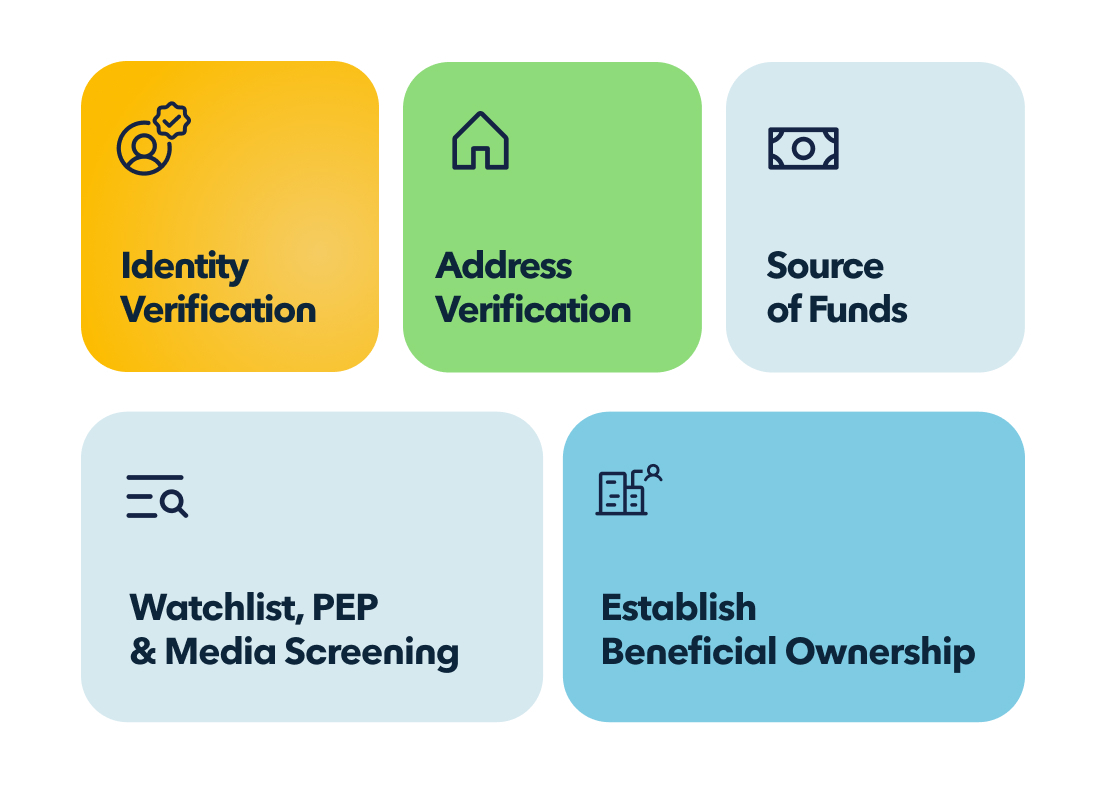
nCino KYC’s FICA compliance solution covers the full range of KYC obligations, from standardised risk rating to instant screening against AML watchlists, adverse media, and sanctions lists. The onboarding experience is designed to be enable remote and paperless interactions where preferred, which matters not just for operational efficiency but for client experience. Institutions often underestimate how much friction exists in their current onboarding processes, friction that costs them time, costs their clients patience, and occasionally costs them the relationship entirely. Real-time verification powered by embedded data allows risk to be assessed as information arrives, rather than weeks later, with centralised document management handling client information and compliance requirements automatically.
The risk rating component deserves a specific mention. An Automated Client Review solution which is a fully configurable allowing institutions to define, create and implement their own risk rating solution is essential. This means the system reflects the institution’s RMCP, not the other way around. For compliance professionals who have spent years watching the gap widen between what the board approved and what staff actually do, this is not a small thing. It is the difference between a compliance programme that functions on paper and one that functions in practice.
There is also something worth saying about the human element here, not to dismiss it, but to reframe it. Beneficial ownership verification, PEP screening, and risk assessments can be better managed within a system without requiring sales or finance teams to become FICA specialists. This is important because in most accountable institutions, the people who interact with clients are not compliance officers. They are salespeople, advisors, relationship managers, conveyancers, brokers. Asking them to simultaneously drive revenue and manually execute a sophisticated due diligence process is asking too much, and the compliance failures that result are not really their fault. Embedding the compliance workflow into the ordinary client onboarding process means that it happens as a matter of course, without requiring every client-facing employee to hold a specialized FICA qualification.
And then there is the audit trail question, which tends to become very urgent, very quickly when the FIC shows up. Every verification, every screening result, and every risk rating is captured, stored, and ready for inspection. A timestamped, system-generated compliance record tells a coherent story. A folder of PDFs reconstructed from an email chain does not. The difference between the two, when a regulator is asking questions, is not trivial.
Grey Listing Has Changed the Calculus
South Africa’s grey listing has sharpened everything. The FIC is under pressure to demonstrate that the country’s AML/CFT framework is functioning as it should, and that pressure flows directly to accountable institutions. Inspections are more frequent, findings are more consequential, and the tolerance for “we were trying our best with the tools we had” is considerably thinner than it used to be. Institutions that have delayed investing in proper KYC infrastructure are running out of runway to do so comfortably.
Automation Handles the Routine, Professionals Handle the Exceptional
None of this means that automation makes compliance easy, or that technology replaces the need for skilled compliance professionals. It does not. What it means is that the compliance professional’s time and expertise are far better spent on the judgement calls that actually require human insight. These include complex beneficial ownership structures, high-risk client decisions, the nuanced EDD assessments as opposed to chasing documents and running manual checks on a sanctions portal. Automation handles the routine. The professional handles the exceptional. That division of labour is not a threat to the compliance function. It is what makes the compliance function sustainable.
As always, nCino KYC is committed to bringing you the latest news and information relating to the FIC Act. If you haven't already, sign up to our Newsletter to keep updated with the latest Financial Crime, AML and FICA compliance news.